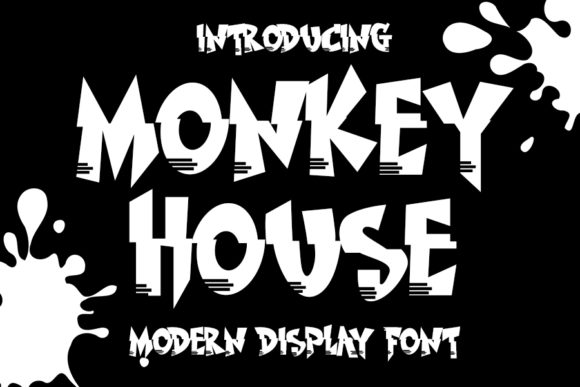
Monkey House: A Strategic Evaluation for Distinctive Display Typography
In the landscape of digital and print design, selecting the right typeface is rarely a binary decision between legibility and aesthetics. It is a nuanced process of balancing brand voice, medium constraints, and audience expectations. For designers seeking a font that commands immediate attention without sacrificing structural integrity, Monkey House emerges as a compelling candidate. This unique display font offers a specific set of characteristics that differentiate it from standard sans-serifs and decorative scripts alike.
Understanding the utility of Monkey House requires looking beyond its visual novelty. While many fonts are designed primarily for body text or technical documentation, this typeface occupies a specialized niche. It is engineered to function as a headline tool, where the primary goal is to stop the scroll, grab the eye, and establish a distinct mood before a single word of body copy is read. When added to your creative ideas, notice how it will make them stand out by injecting a sense of playful unpredictability into otherwise rigid layouts.
Defining the Character of Monkey House
The core identity of Monkey House lies in its irregularity. Unlike geometric sans-serif fonts that rely on perfect circles and uniform stroke widths, Monkey House embraces a more organic, hand-drawn quality. The letterforms often feature slight variations in weight, subtle imperfections in the curves, and a personality that feels approachable yet bold. This distinction makes it particularly effective for projects that aim to convey creativity, fun, or a human-centric approach.
When evaluating any display font, the first metric is usually character set completeness and kerning consistency. Monkey House addresses these technical requirements while maintaining its artistic flair. The spacing between letters is calibrated to ensure readability even at larger sizes, preventing the chaotic look that often plagues novelty typefaces. This balance allows the font to remain legible across various media, from large-scale billboards to mobile app interfaces, provided the context supports its expressive nature.
The visual weight of the characters is another defining factor. The strokes are generally thick and confident, allowing the font to hold its own against complex imagery or busy backgrounds. However, this boldness comes with a caveat: it is not suitable for small text blocks or dense paragraphs. The design intent is clear—it is meant to be seen, not read in isolation over long durations. This limitation is not a flaw but a feature that guides the designer toward appropriate usage scenarios.
Comparative Analysis: Placement in the Typography Ecosystem
To fully appreciate the value of Monkey House, it is helpful to compare it with other categories of display fonts. In the broader market, typography often falls into three main buckets for headlines: geometric, humanist, and decorative. Geometric fonts, such as those based on perfect circles and squares, offer a clean, modern, and corporate feel. Humanist fonts provide warmth and readability with a touch of classical influence. Decorative fonts, often used for holidays or specific themes, can sometimes lack versatility and professional polish.
Monkey House sits comfortably between the humanist and decorative categories. It possesses the structural reliability of a well-designed humanist typeface but includes the whimsical elements typically reserved for decorative styles. This positioning creates a unique opportunity for designers who want to avoid the sterility of purely geometric options without resorting to fonts that might look dated or overly themed.
Consider the scenario of a branding project for a children's educational platform versus a high-end architectural firm. For the former, a font like Monkey House aligns perfectly with the need for engagement and approachability. The slight irregularities in the letterforms suggest movement and playfulness, qualities that resonate with young audiences and their parents. Conversely, for an architectural firm requiring precision and stability, a strict geometric sans-serif would be the logical choice. In this comparison, Monkey House serves as a strategic differentiator rather than a universal solution.
Another point of comparison involves the tradeoff between uniqueness and familiarity. Fonts that are too familiar can blend into the background, failing to capture attention in a crowded marketplace. However, fonts that are too obscure can confuse users or appear unprofessional. Monkey House strikes a middle ground; it is distinctive enough to be memorable but grounded enough to be recognized as functional typography. This balance is crucial for brands looking to establish a unique identity without alienating their audience through excessive experimentation.
Strengths and Limitations in Practical Application
Every typeface has a set of strengths that define its best-fit situations, and Monkey House is no exception. Its primary strength is its ability to convey tone instantly. A headline set in this font communicates energy and creativity before the viewer processes the actual words. This makes it an excellent tool for marketing materials, event posters, book covers for fiction or lifestyle genres, and social media graphics where space is limited and impact is paramount.
Furthermore, the font's texture adds depth to flat designs. In an era where minimalist design often dominates, introducing a typeface with subtle variations in line weight can add a layer of sophistication and tactility to a composition. It breaks the monotony of vector-perfect shapes and introduces a sense of craftsmanship.
However, realistic evaluation requires acknowledging limitations. The most significant constraint is scalability in terms of weight variety. If a project requires a range of weights from light to black to create hierarchy within a single document, Monkey House may not offer the necessary flexibility compared to comprehensive family fonts. Additionally, its informal nature restricts its use in formal contexts. Legal documents, financial reports, or serious news publications would likely find the font inappropriate due to its inherent playfulness.
Another consideration is compatibility with serif body text. While pairing a display font with a serif body font is a classic technique, the specific style of Monkey House requires careful selection of a companion typeface. A highly ornate serif might compete too strongly with the irregularity of the display font, resulting in visual clutter. A simple, neutral serif or a clean sans-serif often provides the best contrast, allowing Monkey House to shine as the focal point.
Decision Factors for Implementation
When deciding whether to incorporate Monkey House into a project, designers should evaluate several key factors. The first is the target audience. Does the demographic respond to casual, friendly, or quirky aesthetics? If the answer is yes, this font can significantly enhance user engagement. If the audience expects formality, authority, or tradition, the font may undermine the intended message.
The second factor is the medium of delivery. Digital screens render type differently than print. On high-resolution displays, the nuances of Monkey House's strokes are easily appreciated. However, on low-resolution screens or in print runs with limited ink coverage, the finer details might get lost or cause rendering issues. Testing the font at the intended size and resolution is a critical step before finalizing a design.
The third factor is the longevity of the content. Trends in typography change rapidly. A font that feels trendy today might seem dated in five years. Monkey House has a timeless quality rooted in its hand-drawn aesthetic, which tends to age better than fonts tied to specific stylistic movements. Nevertheless, it is essential to consider whether the brand's identity is static or evolving. If the brand plans to pivot towards a more corporate direction, investing heavily in a highly stylized display font might limit future rebranding efforts.
Alternatives and Complementary Approaches
If Monkey House does not align with the specific needs of a project, there are alternative approaches to achieving similar results. Designers might opt for variable fonts that allow for dynamic adjustments in weight and width, offering more control over the final appearance. Alternatively, custom lettering services can create bespoke typography that captures the exact spirit of a brand without the generic feel of a stock font.
For those seeking a similar vibe but with a different flavor, exploring fonts with varying degrees of "handmade" qualities can be beneficial. Some alternatives might lean more towards graffiti styles, while others might focus on retro revivalism. The key is to identify the specific emotional trigger required by the project and select a typeface that delivers that emotion most effectively.
In some cases, the solution is not to change the font entirely but to modify its presentation. Using Monkey House in combination with graphic elements, such as textures, gradients, or illustrations, can amplify its strengths and mitigate its weaknesses. The font acts as a foundation upon which the rest of the design builds, creating a cohesive visual narrative.
Final Considerations for the Modern Designer
The choice of typography is one of the most impactful decisions a designer can make. It sets the stage for all subsequent content and influences the user's perception of the entire experience. Monkey House offers a powerful tool for those willing to embrace its unique character. It is not a font for every situation, but when applied correctly, it transforms ordinary layouts into memorable experiences.
By understanding its strengths, limitations, and ideal use cases, designers can leverage Monkey House to elevate their work. Whether used for a bold campaign headline, a creative book cover, or a playful web banner, this font invites viewers to pause and engage. As you explore your next creative idea, consider how adding Monkey House to your toolkit might help your designs stand out in a saturated digital environment. The result is often a striking balance of personality and professionalism that resonates deeply with audiences.